

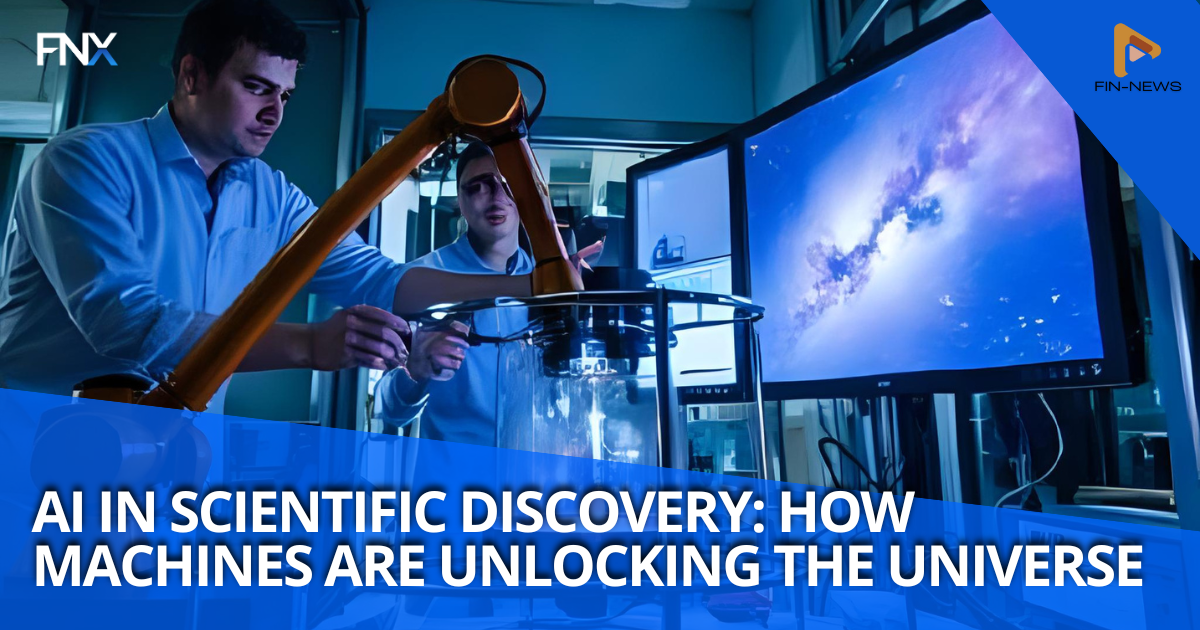
Artificial Intelligence (AI) is no longer confined to recommendation engines or chatbots. In 2025, it has become one of the most powerful tools in scientific discovery — unlocking secrets of the universe that were previously beyond human reach.
🌌 From Telescopes to Algorithms: Mapping the Cosmos
Astronomy, long a field driven by data, is now powered by AI. Projects like NASA’s James Webb Space Telescope and India’s Aditya-L1 solar mission are generating petabytes of data that would take decades to analyze manually. AI algorithms now assist in identifying exoplanets, tracking supernovae, and detecting gravitational waves in real-time.
🧬 In the Lab: AI Accelerates Breakthroughs in Medicine
In biomedical science, AI is doing what no human can — scanning millions of genetic sequences in seconds. At the Indian Council of Medical Research (ICMR), AI tools are being used to develop predictive models for cancer, tuberculosis, and even post-COVID complications.
🧪 Chemistry and Materials Science: Faster, Smarter, Cheaper
AI is also transforming how new materials are discovered. Researchers are using deep learning to simulate how atoms interact — identifying superconductors, better solar materials, and new battery compounds. In India, the Council of Scientific and Industrial Research (CSIR) partnered with IITs to launch an AI-driven Material Discovery Platform, aiming to develop more efficient energy storage solutions.
🔬 Challenges: The Human + Machine Equation
While AI accelerates discovery, it also raises questions about bias, reliability, and accountability. Scientific discoveries have always demanded rigor, replication, and skepticism — qualities machines lack. “AI must remain a co-pilot, not a driver,” says Dr. Leena Bhattacharya, a computational physicist from Kolkata. “Human intuition, ethics, and domain knowledge are still irreplaceable.”
🔭 The Future: AI as a Scientific Collaborator
We are entering an era where scientists may spend more time training AI models than working at lab benches. AI is not just a tool — it's becoming a collaborator, offering new hypotheses, suggesting methods, and even writing code for experiments.
As governments and academic institutions invest heavily in AI-integrated research, the next Einstein might just be a team of humans and machines.
Leave a comment
Your email address will not be published. Required fields are marked *